It appears that some children have more difficulty with everyday physical activities than expected.
They could have difficulty tying their shoelaces, using cutlery, catching a ball, writing clearly, or learning to ride a bicycle, and might often bump into furniture, drop objects, or avoid playground activities.
It may be assumed by adults that the difficulties of a child who is autistic are merely part of the condition.

Sometimes they are not.
The child could also have a developmental coordination disorder, usually referred to as DCD or dyspraxia.
Visual-Spatial Learning Disorder Is More Common Than Thought – StepUp to Learn https://stepuptolearn.com/blogs/research/visual-spatial-learning-disorder-is-more-common-than-thought
Dyspraxia Was the Beginning of Our Search
The first diagnosis that my son was given was dyspraxia.
I started looking into all the information I could find at that time, and while I was doing so, I found out that actor Daniel Radcliffe had spoken in public about having dyspraxia and about having trouble with things like tying his shoes.
The fact that I was able to meet someone who was successful and had the same diagnosis as my son gave me a sense of hope.
It also made me curious.
I wanted to find out what dyspraxia meant for my son, what sorts of difficulties might be associated with it, and how we could help him. Although the initial diagnosis didn’t answer all my questions, it encouraged me to continue learning and searching.
We soon found out that there were more pieces to the puzzle of my son’s development.
What Is Dyspraxia?
Developmental coordination disorder is a condition that affects physical coordination. A child’s movement skills are significantly below what would normally be expected for their age, and those difficulties interfere with daily activities or school performance.
Sulaiman, M., Baig, M. O., Memon, S. I., Ashraf, N., Butt, P., Afzal, K., and Iqbal, R. (2022) ‘The effects of trampoline exercises in children with developmental coordination disorder: a randomized controlled trial’, Physikalische Medizin Rehabilitationsmedizin Kurortmedizin. https://doi.org/10.1055/a-1755-8655
Dyspraxia can affect both gross and fine motor skills.
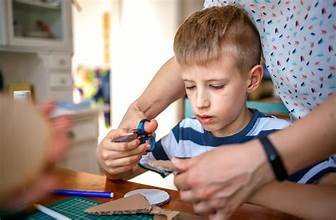
How occupational therapy helps children with autism to thrive – OrbRom | Special Needs & Therapy Center https://autismcambodia.com/how-occupational-therapy-helps-children-with-autism-thrive/2382/
Gross motor skills involve larger movements, such as running, jumping, climbing, balancing, or throwing a ball.
How occupational therapy helps children with autism to thrive – OrbRom | Special Needs & Therapy Center https://autismcambodia.com/how-occupational-therapy-helps-children-with-autism-thrive/2382/
Fine motor skills include small movements, for example, holding a pencil, buttoning buttons, using scissors, or handling small objects.
It is not just a matter of carelessness when a child has dyspraxia; difficulty may exist in their brain and body in relation to planning, organizing, and carrying out coordinated movements.
Signs Parents May Notice
Every child is different, but possible signs of dyspraxia may include:
- Frequently falling, tripping, or bumping into objects
- Dropping or spilling things
- Difficulty using forks, spoons, or cups
- Trouble fastening buttons, zippers, or shoelaces
- Messy, slow, or tiring handwriting
- Difficulty using scissors
- Trouble catching, kicking, or throwing a ball
- Avoiding sports or playground activities
- Difficulty learning to ride a bicycle
- Taking longer to get dressed
- Struggling to copy movements
- Becoming frustrated with multistep physical tasks
Children with DCD may also become reluctant to participate in physical activities because those activities require so much effort or have led A child who refuses to take up a sport might not be being obstinate; instead they could be afraid of failing, of falling, of being laughed at, or of letting down their team.t, or letting down their team.
Why Dyspraxia Can Be: Autistic children usually have problems with movement and coordination, but their difficulties in this area are not always given the same amount of attention as their communication, sensory, or behavioral needs.

Research has discovered that a high proportion of autistic children have significant motor difficulties, even though not all autistic children who have motor challenges fulfill the diagnostic criteria for DCD. The two conditions can also overlap. An autistic child might avoid gym class since it is noisy, unpredictable, and socially overwhelming, and a child with dyspraxia might avoid it because running, catching, balancing, and following movement sequences are difficult. A child who has both autism and dyspraxia could be having to cope with all of those difficulties at the same time. All those challenges at once.
If we understand why people avoid something, adults can offer more useful support.
Dyspraxia Can Affect More Than Movement
The emotional aspect of dyspraxia can also affect a child’s physical difficulties.
Picture having to carry out a task while your hands fail to help you, and imagine being the last one picked for games, other children laughing at you when you fall, or being told to hurry while you are getting dressed.
Over time, a child may begin saying:
- “I can’t do it.”
- Don’t want to attempt it.
- “I hate the gym.”
- “You do it instead of me.”
- “I’m not good at anything.”
The words might sound as if they show defiance or indicate a lack of motivation, but they could instead be signs of frustration and damaged self-confidence.
Children have to understand that having difficulty with coordination doesn’t mean that they are lazy, unintelligent, or incapable.
How Is Dyspraxia Evaluated?
No single blood test or scan can diagnose DCD.
A pediatrician, an occupational therapist, a physical therapist, or some other developmental professional might be involved in the evaluation. This professional could review the child’s developmental history, observe how the child moves, assess their motor skills, and consider the impact of the difficulties on daily life. It is also necessary to consider any other medical reasons for the movement problems.
Parents can make a difference by giving specific examples.
Instead of saying, “My child is clumsy,” explain what you see:
- I am unable to have my child button things by themselves.
- Handwriting: My child falls more frequently than other children of the same age. To learn a new physical task, you need to practice repeatedly. My child avoids eating some foods because it is difficult for them to use utensils. It takes a very long time to get them dressed. Examples of the problem will help professionals see how it affects your child on a day-to-day basis.
Ways to support should be according to the individual needs of the child. Strategies that may be helpful include: full strategies may include:
- Breaking activities into small steps
- Demonstrating one movement at a time
- Allowing extra time for dressing and schoolwork
- Using pencil grips or adapted scissors
- Providing shoes with Velcro or elastic laces
- Practicing skills privately before group activities
- Offering alternatives to competitive sports
- Using visual instructions
- Allowing keyboarding when handwriting is exhausting
- Working with occupational or physical therapists
- Praising effort, rat. What we aim for is not to look after every aspect of the child’s life. The aim is to break down the tasks so that the child can carry out some practice, experience success, and then slowly become more independent.
Keep Looking. The explanation of dyspraxia accounted for many aspects of my son’s condition, but it couldn’t account for all of them. The feeling prompted me to keep asking questions.
It is sometimes the case that parents fear that by requesting a further evaluation, they are looking for something “wrong” with their child, but I don’t see it that way.
Gaining a greater understanding of your child doesn’t alter who they are.
It can help you to see why some tasks are difficult, why certain traditional methods are not working, and what sort of assistance might make a difference.
It may take your child longer.
They might have to learn in a different way.
What seems simple from the outside might,t in fact, feel extremely complicated to them and thus may require adults to realize this.
Most importantly, they need to know that difficulty with coordination does not define their intelligence, their worth, or their future.
Dyspraxia was the first answer we received in our family’s journey. It was not the last, but it gave us a place to begin.
Sometimes one answer leads to another.
And sometimes that first answer gives a parent the confidence to keep searching until the larger picture finally begins to make sense.
Medical note: This article is for general educational purposes and is not a substitute for professional medical advice, evaluation, diagnosis, or treatment. Speak with a qualified healthcare professional if you are concerned about your child’s movement, coordination, development, or daily functioning.
Here are some websites that can give you some more information:
Cleveland Clinic: https://my.clevelandclinic.org/health/diseases/23963-dyspraxia-developmental-coordination-disorder-dcd
Child Mind Institute: https://childmind.org/article/problems-coordination-dyspraxia/