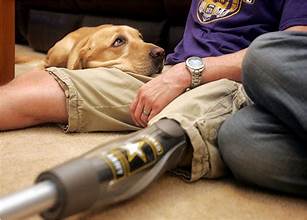
When you start looking into psychiatric service dogs, it can be confusing to realize there isn’t just one set of laws to follow.
There are federal laws and state laws. There are different rules for housing.
Different rules for airplanes.
State laws can also cover topics that the federal ADA rules do not.
It’s easy to see why families might feel confused.
Today, we’ll break down how state service dog laws work together with federal protections.
This article is for general education only and isn’t legal advice. Service-animal laws can change, so be sure to check the current law for your state and situation.
Start With the Federal ADA
For public access in places covered by Titles II and III of the Americans with Disabilities Act, a service animal generally means a dog individually trained to perform work or tasks for a person with a disability.
Office Policies – Goodskin Dermatology https://goodskinmd.com/service-animal-policy/
The disability can be physical, sensory, psychiatric, intellectual, or another qualifying disability.
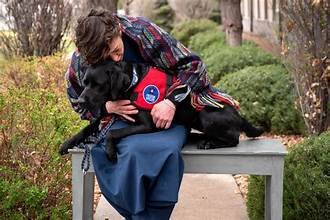
Psychiatric service dogs are not placed into a lower category simply because the disability is psychiatric.
This federal baseline is very important.
However, it’s not the whole story.
Why Do State Laws Matter?
States can have their own service-animal statutes.
A 50-state comparison maintained by Michigan State University’s Animal Legal & Historical Center shows that state laws address subjects including:
- Public accommodation
- Service dogs in training
- Interference with or injury to service animals
- Licensing
- Protections for pedestrians
- Fraudulent representation of service animals
These details can vary widely by state.
That’s why saying, “The ADA says…” might not answer every question about service dogs.
Difference #1: Service Dogs in Training
This is a key area that families and owner-trainers should look into.
The ADA does not give a dog that is still in training the same federal public-access status as a fully trained service dog.
However, state laws may provide additional access rights for service dogs in training.
Even in states that offer these rights, the details can still be different.
A law may apply to:
- Professional trainers
- Trainers working with particular organizations
- People with disabilities training their own dogs
- Particular categories of service animals
This is especially important if you are training your own service dog.
Before you practice public-access skills in places where pets aren’t usually allowed, check your state’s specific law.
Difference #2: Interference With a Service Dog
Many states have laws addressing people who intentionally injure, harass, interfere with, or allow another animal to harm a service dog.
The penalties vary.
Michigan State’s 50-state comparison found that nearly all states have some form of law addressing criminal interference, theft, or assault involving assistance animals, although the exact definitions and penalties vary.
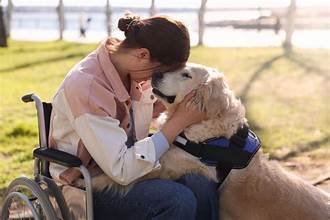
This protection matters because interfering with a service dog affects more than just the animal.
It can take away a person’s ability to safely do everyday tasks.
Difference #3: Service-Dog Licensing
Ordinary local dog-licensing requirements can also interact with state service-dog laws.
Some states provide licensing-fee exemptions or waivers for qualifying service dogs.
Others may have different documentation procedures for receiving those exemptions.
According to the state-law comparison, roughly half of states provide some form of service-dog licensing fee waiver or exemption.
This is another reason why statements like “service dogs never need paperwork” can be misleading.
Under the ADA, businesses cannot require service-dog certification.
But a separate state or local administrative program, such as receiving a dog-license fee exemption, may have its own process.
These are two separate issues.
Difference #4: Fake Service-Dog Laws
More states have also adopted laws addressing fraudulent representation of service animals.
The exact wording and penalty vary.
Michigan State’s comparison reports that more than half of states have laws making some form of fraudulent service-animal representation an offense.
Why is this important?
Because fake service-dog claims can create real problems for disabled handlers.
Poorly controlled pets presented as service animals can distract, frighten, or even injure legitimate working dogs.
They can also contribute to suspicion toward people whose disabilities aren’t visible—including psychiatric disabilities.
Psychiatric Service Dogs Are Still Service Dogs
This topic needs its own section because people with invisible disabilities are sometimes treated differently.
No one should have to “look disabled enough” to have a legitimate service dog.
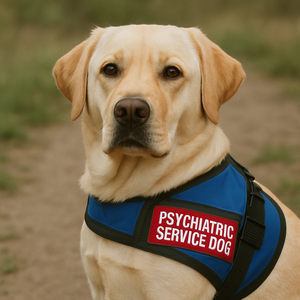
The ADA specifically recognizes service-dog work for psychiatric disabilities.
Examples from Department of Justice guidance include medication reminders, interrupting destructive behaviors, grounding responses, safety checks, and trained responses to psychiatric episodes.
A dog’s legitimacy isn’t based on whether others can see the handler’s disability.
It depends on whether the legal requirements are met.
What Can Businesses Ask?
Under the ADA, when the dog’s role isn’t obvious, staff generally may ask:
1. Is the dog a service animal required because of a disability?
2. What work or task has the dog been trained to perform?
They may not require ADA service-dog certification, demand that the dog perform the task, or require disclosure of the person’s diagnosis.
This federal rule is a key starting point, even as you look into extra state protections.
Don’t Rely on a Random Chart Forever
Charts and summaries are great places to start.
But laws change.
If a specific legal question is important for your family, take an extra step.
Look for:
- Your state’s official statutes
- State disability-rights agencies
- Attorney General information
- State or local government guidance
- Current federal ADA guidance
State laws might also use different words or terms.
If you search for “psychiatric service dog law,” you might miss laws that use terms like “service animal” or “assistance animal.”
The Best Approach: Think in Layers
Rather than searching for one perfect website with every answer, try thinking about the law in layers:
Federal ADA rules: public access in many everyday settings.
State law: additional rights, protections, penalties, and service-dog-in-training provisions.
Housing law: a separate legal framework.
Air travel: Air Carrier Access Act and Department of Transportation rules.
International travel: destination-country laws and animal-import requirements.
When you see the law in these layers, it becomes much easier to understand.
That last layer, international travel, is what we’ll cover next.
Crossing an international border with a service dog often involves much more paperwork than simply bringing your dog into a local store.