If you’ve looked into psychiatric or autism service dogs, you’ve probably seen the term Deep Pressure Therapy, or DPT. It might sound simple. The dog applies pressure to the person’s body. But how does a dog learn to do this reliably?
I found this question especially interesting because many articles mention DPT as a service dog task but don’t explain how the training actually works. Let’s take a closer look together.
What Is Deep Pressure Therapy?
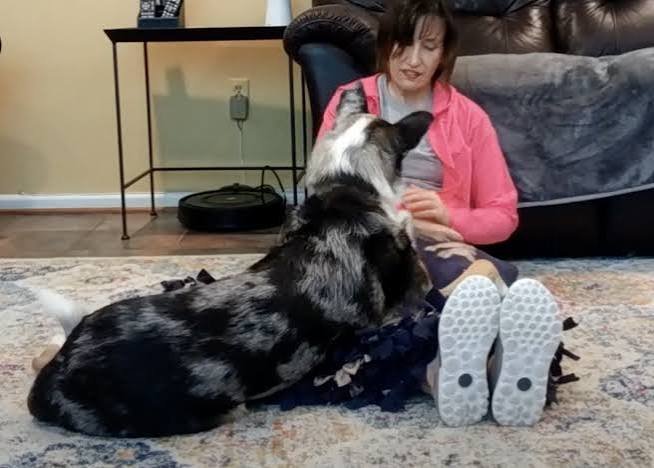
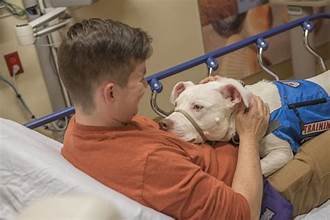
DPT usually means teaching a dog to keep steady physical contact or body pressure on a specific part of the handler’s body.
Depending on the dog’s size and the person’s needs, this could include:
- Lying across the lap or legs
- Leaning firmly against the person
- Lying partly across the torso
- Resting the dog’s head or chin against the person
- Maintaining physical contact until given a release cue
There isn’t one exact position that works for everyone.
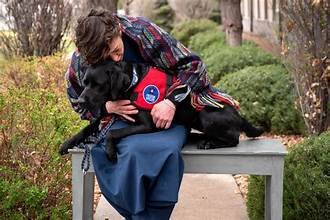
What matters most is finding a behavior that’s helpful and safe for each handler.
Is There an Official DPT Training Protocol?
Here, it’s important to separate what the law says from how training is actually done.
The ADA does not provide a step-by-step DPT training protocol.
It does not tell handlers which command to use, how many repetitions the dog needs, or exactly where the dog should place its body.
Federal ADA rules focus on whether the dog has been individually trained to perform work or a task that is directly related to the person’s disability.
Professional trainers might use different methods.
Still, there are some common training principles that help explain how DPT is taught.
Step 1: Build the Foundation First
Before a dog learns to lie across someone for several minutes, trainers usually start with easier foundation behaviors.
One service dog training program suggests first teaching the dog to settle on a small mat or target and to get comfortable lying on different surfaces. That makes sense.
Imagine trying to teach:
“Climb onto me, lie in exactly this position, stay there despite me moving, and don’t leave until I release you.”
That’s really a combination of several behaviors.
Breaking the task into smaller steps helps the dog understand what to do.
Step 2: Teach the Position
Next, the dog needs to learn where to go.
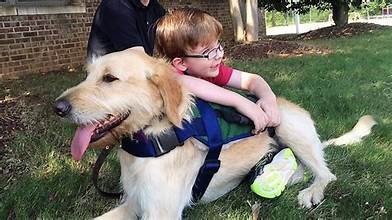
A larger dog may only need to place part of its body over the handler’s legs.
A smaller dog might lie more fully across the lap.
Another handler might use a chin rest or sustained lean.
The dog’s size makes a difference.
The person’s comfort and medical needs matter even more.
This is one reason working with an experienced trainer can be valuable when determining the safest position.
Step 3: Reward the Correct Behavior
Positive reinforcement can be used to teach the dog that moving into the correct position is worthwhile.
At first, the dog may receive a reward simply for approaching or placing its paws in the desired position.
Then the criteria gradually become more specific.
The goal isn’t to rush toward the finished task.
It is to help the dog understand each part.
Step 4: Build Duration Slowly
Getting into position isn’t enough.
A dog performing DPT may need to remain in position.
Service-dog trainers often recommend building that duration gradually rather than expecting several minutes immediately.
For example, the dog might hold the behavior briefly and receive reinforcement.
Then the time is slowly increased.
If the dog repeatedly leaves the position, that may be a sign that the training advanced too quickly.
A training approach described by At Your Service Dog Training emphasizes gradually increasing duration while occasionally returning to easier, shorter repetitions so the dog continues to succeed.
Step 5: Teach a Clear Release Cue
This may be one of the easiest steps to overlook.
The dog needs to know not only:
“Start the task.”
but also:
“The task is finished.”
A clear release word helps the dog understand when it can leave the position.
Without one, the dog may decide for itself when the task has ended.
That isn’t ideal when reliability matters.
Step 6: Practice With Movement
People don’t stay perfectly still during distress.
Someone may:
- Shake
- Rock
- Shift position
- Cry
- Move their hands
- Breathe differently
A dog that only performs DPT while someone sits perfectly still on the living-room couch may not understand what to do in a real situation.
Training, therefore, needs to gradually include realistic movement while keeping the dog comfortable and successful.
Step 7: Practice in Different Environments
This is called generalization.
A dog might perform perfectly at home but become confused at a doctor’s office.
In a park.
Or when another dog walks past.
When someone approaches to ask, “Can I pet your dog?”
So once the behavior is reliable in a quiet environment, distractions can be added gradually.
The difficulty should increase slowly.
A service dog isn’t just learning a trick.
The dog is learning to perform a task when life around the handler may be unpredictable.
Eventually, the Dog May Learn to Respond to a Symptom
Some dogs may initially perform DPT only after receiving a cue.
More advanced training may connect the task to a recognizable behavior or symptom from the handler.
For example, a dog could be trained to respond to a particular repetitive movement or other observable sign.
This connects with something the Department of Justice has emphasized about psychiatric service-dog work: there is a difference between a dog simply noticing distress and a dog trained to respond with a particular action.
That trained response is what matters.
DPT Is More Than a Dog Giving a Hug
That may be my biggest takeaway from researching this subject.
At first glance, Deep Pressure Therapy can look like cuddling.
But reliable task training involves much more:
position + cue or trigger + sustained behavior + release + reliability across situations.
That is why simply saying, “Service dogs can provide Deep Pressure Therapy,” doesn’t really tell families enough.
Understanding how the task is built helps explain the difference between a comforting pet behavior and specifically trained service-dog work.
And next week, we’re going to move from training into another complicated part of psychiatric service dogs: The law.