When your child has a disability, you get used to paperwork.
IEPs.
504 plans.
Evaluations.
Meetings.
Accommodations.
Progress reports.
If your child starts using a service dog, you have another question to consider:
How do I get the school to allow my child’s service dog to come with them?
At first, it might seem like the answer is, “Put it in the IEP.”
But it’s not always that simple.
Service animals in public schools can involve several different federal laws, including the Americans with Disabilities Act (ADA), Section 504 of the Rehabilitation Act, and the Individuals with Disabilities Education Act (IDEA).
McNamara, S. (2026). Understanding Laws and the IEP Process. https://doi.org/10.4324/9781003638483-3
One of the most important things for parents to know is this:
A student’s right to use a qualifying service animal at a public school does not automatically depend on whether an IEP or 504 team decides the dog is educationally necessary.

That doesn’t mean the IEP or 504 plan isn’t important.
It means you may need to answer two different questions:
- Does my child have the right to bring their service dog to school?
- What supports does my child need to successfully use that service dog during the school day?
Knowing the difference can make the whole process easier.
Parent Note: This article provides general educational information about U.S. federal disability laws. State laws and individual circumstances can differ, so families dealing with a dispute may want to consult a disability-rights organization or qualified attorney. Organizations such as The ARC, Disability Rights Education & Defense Fund (DREDF), and local Parent Training and Information Centers (PTIs) can offer information and resources. Many states also have Protection and Advocacy agencies that help families navigate disability rights issues.
First, what counts as a service dog?
Under the ADA, a service animal is generally a dog that has been individually trained to perform work or tasks for a person with a disability.
The task must be directly related to the person’s disability.
Examples might include a dog trained to:
- Alert someone to an approaching seizure.
- Retrieve dropped items for someone with a mobility disability.
- Guide someone who is blind or has low vision.
- Alert a person who is deaf or hard of hearing.
- Interrupt certain disability-related behaviors.
- Alert to changes associated with a medical condition.
- Perform a specific trained response during a psychiatric episode.
A service dog is not the same as a pet or an emotional support animal.
A dog’s presence can help a child feel calmer or safer. However, under the ADA, comfort alone does not make a dog a service animal. The dog must be trained to do a specific task related to the disability.
This difference is important when you talk with the school.
Can Service Dogs Go to Public Schools?
In most cases, yes.
Public schools are covered by Title II of the Americans with Disabilities Act, which applies to state and local government programs and services.
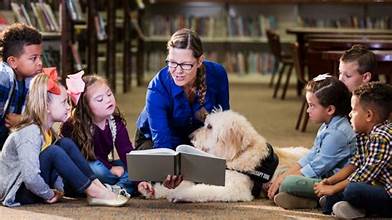
The U.S. Department of Justice specifically includes schools among the places where service animals generally must be allowed to accompany their handlers.
This means a school cannot just say:
“We don’t allow animals.”
A service dog is not at school as a pet.
The ADA generally requires public entities to modify their policies when necessary to permit an individual with a disability to use a service animal.
There are limited situations in which a service animal may be removed, such as when the animal is not housebroken or is out of control, and the handler does not take effective action to control it.
So, does the Service Dog Have to Be Put in the IEP?
Here’s where things get a bit more complicated.
Not always.
A student may have rights under the ADA that exist separately from the services included in an IEP.
In one U.S. Department of Education Office for Civil Rights investigation involving a student’s service dog, OCR explained that a student’s ability to use a service animal at school is independent of whether the animal is required for the student to receive a free appropriate public education under Section 504.
To put it simply:
The school shouldn’t treat the IEP or 504 meeting as a vote on whether the ADA applies.
But that doesn’t mean you should leave the service dog out of your child’s educational planning.
Actually, the opposite is true.
When an IEP Can Be Important
An Individualized Education Program (IEP) is under IDEA.
An IEP is designed for a child who qualifies for special education under IDEA and describes the child’s individual educational needs, goals, services, supports, and accommodations.
If the service dog affects how your child learns, moves around school, joins activities, becomes more independent, or gets disability-related support, it’s a good idea to talk about these needs with the IEP team.
IDEA regulations even specifically recognize the use of a service animal in certain orientation and mobility services for students who are blind or visually impaired.
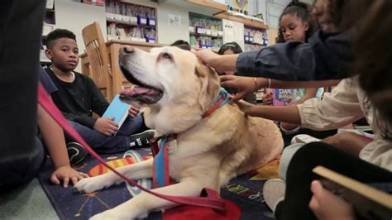
Depending on your child’s individual situation, an IEP discussion might include things such as:
- How will your child handle the dog while moving between classrooms?
- Whether staff need to give reminders or cues.
- How the service dog will accompany your child during specials, assemblies, lunch, or recess.
- Transportation arrangements.
- Field trips.
- Emergency drills.
- What happens if your child temporarily cannot manage part of the dog’s routine?
- Disability-related independence goals involving the dog.
The main thing is to focus on your child’s specific needs, not just the fact that the dog is there.
What About a 504 Plan?
A Section 504 plan serves a somewhat different purpose.
Section 504 is a federal civil rights law that protects individuals with disabilities from discrimination in programs that receive federal financial assistance.
A student may qualify for protections under Section 504 even if they do not qualify for special education under IDEA.
Public schools may need to provide reasonable modifications, accommodations, related aids, or services so that a student with a disability has meaningful access to school programs and activities.
For some students, a 504 plan can be an excellent place to document how a service dog will be used throughout the school day.
For example, one OCR case described a student’s 504 plan containing provisions addressing the student’s service dog, including access around campus, water and bathroom breaks, staff awareness, alerts performed by the dog, and what would happen if the dog were absent.
Not every child’s plan needs to be the same.
It just shows that careful planning can help avoid confusion.
IEP vs. 504: Which One Should Parents Use?
Parents don’t need to see this as an either/or choice.
Instead, consider what your child already has and what they need.
Does your child already has an IEP, begin with the IEP team and case manager when discussing educational supports related to the service dog.
Your child has a 504 plan. Talk with the 504 coordinator about disability-related accommodations and how the service dog will be integrated into your child’s school day.
If your child has neither, they may still have ADA rights regarding a qualifying service animal.
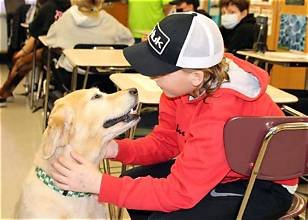
The ADA, Section 504, and IDEA overlap in some areas, but they are not interchangeable.
Parents shouldn’t feel like they need to be lawyers to ask the school a question.
You can start with something much simpler.
How to Request a Service Dog at School
If my family were getting ready to bring a child’s service dog to school, I’d want everything in writing from the start.
Not because I would be looking for a fight.
Because schools are busy places.
Principals, teachers, nurses, transportation departments, special education staff, substitutes, paraprofessionals, and other staff may all need to understand the plan.
Written communication reduces misunderstandings.
Step 1: Contact the School in Writing
You might begin with the principal and your child’s case manager or 504 coordinator.
Explain that your child uses a service dog because of a disability and that you would like to begin planning for the dog to accompany your child at school.
Keep the first message simple.
You do not need to send the school’s entire life story.
Ask what process the district uses for coordinating service-animal access.
Step 2: Explain What the Dog Is Trained to Do
Under the ADA, when it is not obvious that a dog is a service animal, staff are generally limited to two questions:
- Is the dog required because of a disability?
- What work or task has the dog been trained to perform?
The ADA does not allow covered entities to demand service-dog certification, special identification, proof of professional training, or a demonstration of the dog’s task as a condition of access.
That is an important point because there is a tremendous amount of confusion about “service dog certification.”
Under the ADA, service dogs are not required to have a federal certification card or registration.
Step 3: Request a Planning Meeting
Even when the right to use the service dog is clear, the logistics still need attention.
This is where cooperation between the family and school can make a huge difference.
Questions might include:
- Where will the dog rest during class?
- Where can the dog get water?
- Where will bathroom breaks happen?
- How will the dog travel on the school bus?
- What happens during fire drills?
- Will the dog attend PE?
- What happens in the cafeteria?
- How will field trips be handled?
- Who needs to know about the service dog?
- What should substitute teachers know?
- What happens if another student continually tries to pet or distract the dog?
These aren’t reasons to keep the dog out.
There are things worth solving before the first day.
Who Is Responsible for Handling the Service Dog?
This can become one of the biggest questions when the handler is a child.
The ADA generally requires that a service animal remain under the handler’s control.
The Department of Justice also states that covered entities are generally not responsible for the care or supervision of a service animal.
However, DOJ guidance specifically recognizes that in a K-12 school setting, a school may need to provide some assistance to enable a particular student to handle their service animal.
That is a very important distinction.
There is a difference between:
The school is becoming responsible for caring for the dog
and
A staff member providing disability-related assistance that enables the child to handle the dog.
For example, some children may eventually be completely independent handlers.
Another child may need a reminder to give a command.
Another might need help holding a leash while transferring between mobility equipment.
Someone might require more substantial assistance.
These situations need to be considered individually rather than assuming every child must be capable of independently managing every aspect of a service dog before the animal may attend school.
What About Allergies or Fear of Dogs?
This is another concern parents may hear.
“What if another child is allergic?”
“What if a teacher is afraid of dogs?”
Those concerns should be taken seriously.
But the ADA guidance says that allergies and fear of dogs are not, by themselves, valid reasons to deny access to a person using a service animal.
Instead, schools should look for ways to accommodate both individuals.
That could mean changing seating locations or, when possible, arranging different rooms or spaces.
The goal should be solving the problem rather than deciding that one student’s needs automatically cancel out another student’s rights.
When Can a School Ask a Service Dog to Leave?
Service dogs do have behavior expectations.
A school may require a service animal to be removed if:
- The dog is out of control, and the handler does not take effective action to control it.
- The dog is not housebroken.
There can also be unusual circumstances involving legitimate safety requirements or a fundamental alteration of a program. Those situations should be based on the actual circumstances rather than assumptions about dogs in general.
A school shouldn’t create a long list of extra rules for service dogs that goes beyond what disability law allows.
Don’t Forget Transportation and Field Trips
One thing I would encourage parents to do is think beyond the classroom.
A child’s school day begins long before they sit at their desk.
Ask about:
Transportation:
If your child rides the bus, how will the dog board, ride, and exit safely?
Field trips:
Will the dog travel with the class? Does the destination need advance notice?
Lunch:
Where will the dog settle while your child eats?
Recess:
What will the dog do during outdoor activities?
Assemblies:
Where can the child and dog sit comfortably and safely?
Emergency drills:
Does the evacuation plan account for the dog?
After-school activities:
Will the same access plan apply to clubs, events, and other school-sponsored programs?
These little details can become big problems when nobody thinks about them beforehand.
Ask the School to Put the Plan in Writing
Even if everyone agrees during a meeting, ask for the important details to be written down.
Depending on your child’s circumstances, that documentation might appear in an IEP, 504 plan, school service-animal plan, health plan, transportation plan, or another written school document.
You want the people working with your child to know:
- What the dog does.
- What your child is expected to do.
- What staff may need to do.
- How emergencies are handled.
- How transportation works.
- How field trips are handled.
- What happens when the regular teacher or paraprofessional is absent?.
Written plans create consistency.
And consistency is especially important for children who rely on routines and predictable support.
What If the School Says No?
First, ask why.
And ask for the decision in writing.
Sometimes a school’s initial response may come from someone who hasn’t dealt with a service dog before.
A statement such as:
“We’ve never allowed that.”
It is very different from a carefully considered legal decision.
You can politely ask:
- What district policy applies?
- What federal or state requirement is the decision based on?
- Has the district’s ADA or Section 504 coordinator reviewed the request?
- What alternative accommodation is the school proposing?
- Can the decision and its reasons be provided in writing?
If the disagreement involves your child’s IEP or Section 504 rights, you can also ask for information about the applicable procedural safeguards.
Families who believe a school may be violating disability-discrimination laws can also learn about complaint options through the U.S. Department of Education’s Office for Civil Rights or the U.S. Department of Justice.
You Don’t Have to Know Every Law Before Starting the Conversation
I know how intimidating these meetings can feel.
Parents already walk into school meetings carrying folders filled with evaluations, reports, goals, accommodations, medical information, and years of history.
Then suddenly you’re supposed to understand the ADA, IDEA, Section 504, service-animal regulations, and school policy too?
That’s a lot.
You don’t have to walk into that first meeting knowing every regulation.
Start with your child.
What does the service dog do for them?
What does your child need to safely and successfully use that dog at school?
Where might problems come up during the school day?
Those questions give you a place to begin.
Then document your requests, ask questions, and don’t be afraid to request clarification when something doesn’t make sense.
Final Thoughts
A service dog can be much more than an animal accompanying a child through the school doors.
For the right child, that dog may support safety, mobility, medical awareness, independence, communication, regulation, or access to everyday activities.
Parents shouldn’t have to choose between their child’s education and disability support simply because bringing a service animal into a school requires some planning.
The biggest thing I want families to remember is this:
The ADA, IEPs, and 504 plans do not all do the same job.
A public-school student’s right to use a qualifying service dog may exist under the ADA independently of whether the dog is considered necessary for the student’s special education program.
At the same time, the child’s IEP or 504 plan can be an incredibly valuable place to document the accommodations, assistance, routines, and supports that make using that service dog at school successful.
It doesn’t have to begin with a battle.
Sometimes it begins with one email:
“My child uses a service dog because of a disability. I’d like to meet and discuss how we can safely and successfully incorporate the dog into their school day.
And from there, you build the plan together.