Halloween can be an exciting time for families. There are pumpkins on porches, children dressed in costumes, and neighborhoods filled with laughter and excitement.
But if your family has a service dog, Halloween may require a little extra planning.
Think about everything that changes on Halloween night.
Familiar houses suddenly have strange decorations. Children run through neighborhoods wearing costumes. Doorbells ring constantly, and unexpected noises seem to come from everywhere.
Even a well-trained service dog may encounter distractions that differ from those on an ordinary day.
For families raising children with autism, ADHD, or other disabilities, these challenges can become even more complicated.
A service dog may be an important part of a child’s everyday support system. Keeping that dog comfortable, safe, and able to perform its trained tasks should be part of your Halloween preparations.
The good news is that you don’t have to skip Halloween completely.
With a little planning, realistic expectations, and attention to your dog’s needs, you can create an enjoyable experience for everyone.
Here are 12 Halloween safety tips for families with service dogs.
Why Can Halloween Be Challenging for Service Dogs?
Service dogs are trained to perform specific tasks for people with disabilities.
Depending on the person’s needs, those tasks may include retrieving dropped objects, alerting to particular medical changes, interrupting certain behaviors, or performing other trained assistance.
But service dogs are still dogs.
They notice changes in their surroundings, and unfamiliar situations can introduce new distractions.
Halloween presents several potential challenges, including:
- Loud music and unexpected screams.
- Flashing lights and moving decorations.
- Children approaching without warning.
- Unfamiliar costumes and masks.
- Crowded sidewalks and busy streets.
- Candy or food dropped on the ground.
- Other dogs participating in neighborhood celebrations.
- Sudden changes to familiar routines.
A trained service dog may handle many of these situations successfully.
However, it’s important not to assume every dog will be comfortable in every environment.
A service dog’s training matters, but so does the dog’s individual well-being.
That is why preparing ahead of time can make such a difference.
1. Begin Preparing Your Service Dog Before Halloween
Don’t wait until Halloween night to introduce your service dog to every unusual sight and sound.
If possible, begin preparing several days or weeks in advance.
Take short walks through familiar neighborhoods as decorations start to appear.
Allow your dog to observe new objects from a comfortable distance.
A large inflatable ghost or moving skeleton may look very different from the ordinary objects your dog usually sees.
If your dog becomes uncertain, allow space rather than forcing an approach.
Use the positive training methods your dog is already familiar with.
For example, you might reward calm attention and practice known cues in the presence of mild distractions.
Keep sessions short and successful.
If your dog becomes distressed, move farther away or end the practice session.
And if your service dog is still in training, work with your qualified trainer to decide which Halloween environments are appropriate.
The goal isn’t to make your dog tolerate every situation.
It’s to help the dog remain comfortable and confident while performing its trained work.
2. Choose a Familiar Trick-or-Treating Route
Halloween isn’t necessarily the best time to explore an unfamiliar neighborhood with your service dog.
Instead, consider choosing a route you’ve walked together before.
A familiar route may make it easier to anticipate busy intersections, loud decorations, and possible distractions.

Before Halloween, take a daytime walk through the area.
Notice which houses have moving decorations, flashing lights, or loud music.
Look for sidewalks that provide enough room for your family and the dog.
You may also want to identify quieter streets or places where you can take a break.
If your child depends on the service dog for specific assistance, consider how the planned route will affect the dog’s ability to perform those tasks.
Parent tip: You don’t need to visit dozens of houses. A short, positive Halloween outing can be more enjoyable than an exhausting evening.
3. Don’t Force Your Service Dog to Wear a Costume
It’s tempting to dress everyone in the family for Halloween, including the dog.
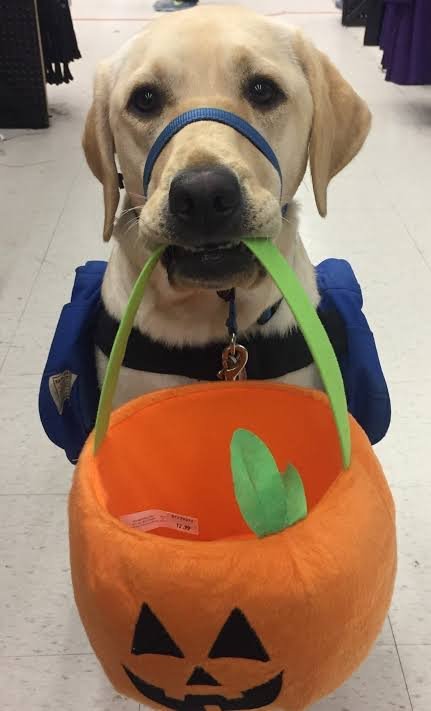
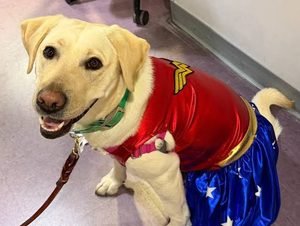
After all, who doesn’t enjoy seeing an adorable dog dressed as a pumpkin?
But service dogs have an important job to do.
A costume that looks cute in photographs could interfere with the dog’s movement, equipment, comfort, or ability to work.
Some dogs also dislike clothing that feels unfamiliar against their bodies.
If you want your dog to wear something festive, consider whether a simple, comfortable accessory is appropriate.
A lightweight bandanna may be an option if it doesn’t interfere with the dog’s working gear or trained tasks.
Whatever you choose, make sure it doesn’t:
- Restrict movement.
- Block vision or hearing.
- Interfere with the harness or leash.
- Create a tripping hazard.
- Contain loose pieces that could be swallowed.
- Cause rubbing, overheating, or discomfort.
Never insist on a costume if your dog is showing signs of stress.
Your service dog’s comfort and ability to work should always come before a Halloween photograph.
Sometimes the best Halloween outfit is simply the dog’s regular working equipment.
4. Protect Your Service Dog From Halloween Candy
Candy may be one of the biggest attractions of Halloween, but it can also be one of the biggest hazards for dogs.
Children may accidentally drop candy or wrappers onto sidewalks.
Others may leave open bags within reach.
Chocolate can be toxic to dogs, and some sugar-free candies contain xylitol, which can cause life-threatening poisoning.
When dogs and chocolates collide!
– Kamloops Veterinary Clinic https://www.kamloopsveterinaryclinic.com/dogs-chocolate-collide/
Raisins and certain other foods can also be dangerous.
For families trick-or-treating with a service dog, careful supervision is essential.
Consider these precautions:
- Keep candy bags closed when possible.
- Teach children not to offer candy to the dog.
- Watch for dropped candy and wrappers.
- Store collected candy somewhere your dog cannot access.
- Bring appropriate dog treats separately if needed.
- Avoid allowing strangers to feed your service dog.
If your dog eats chocolate, xylitol, or another potentially toxic substance, contact your veterinarian or an animal poison control service immediately. Don’t wait for symptoms, and don’t induce vomiting unless a veterinary professional directs you to do so.
Halloween should be filled with treats for the children, not emergency veterinary visits.
5. Help Children Understand That Service Dogs Are Working
Halloween can bring children into close contact with dogs they have never met before.
Many children become excited when they see a friendly-looking dog.
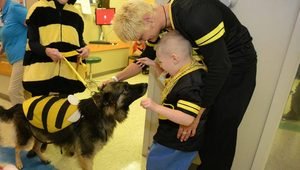
Their first instinct may be to reach out and pet it.

But service dogs are working animals, not neighborhood attractions.
Unexpected touching, calling, or offering treats may distract a service dog from its responsibilities.
For families with service dogs, this can be a good opportunity to teach children how to respond when someone approaches the dog.
You might practice a simple explanation:
“He’s a service dog, and he’s working right now. Please don’t pet him.”
If your child is the service dog handler, teach age-appropriate ways to ask others to give the dog space.
You can also have another adult assist with these conversations when appropriate.
Families without service dogs can help, too.
Teaching children to admire a working dog from a distance is an important part of respecting people with disabilities.
6. Be Careful Around Halloween Decorations
Not all Halloween decorations are harmless to dogs.
Some decorations make sudden noises when someone walks past.
Others move unexpectedly or contain flashing lights.
Fog machines, electrical cords, artificial spiderwebs, and small plastic decorations may create additional hazards.
Your service dog may have encountered unusual objects during training, but that doesn’t mean every Halloween decoration will be familiar.
Pay attention to your dog’s reactions.
If a particular decoration causes distress, move away.
Never force your dog to investigate something frightening simply because other people think it’s funny.
Keep your dog away from electrical cords, open flames, and decorations that could become tangled in its equipment.
And remember, your family can always skip a heavily decorated house.
One less piece of candy is a small price to pay for a safer evening.
7. Watch for Signs That Your Service Dog Needs a Break
As parents of children with special needs, we often learn to recognize when our children are becoming overwhelmed.
Service dog handlers also need to pay attention to their dogs.
A dog that is uncomfortable may begin showing changes in behavior.
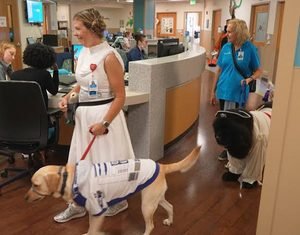
Some possible signs of stress include:
- Repeated lip licking or yawning outside normal contexts.
- Trembling or attempting to move away.
- Tucking the tail or lowering body posture.
- Unusual panting when the dog isn’t hot.
- Difficulty settling or maintaining attention.
- Repeated attempts to avoid a particular situation.
These signs should be considered together with the situation and the dog’s usual behavior.
If your dog seems uncomfortable, create some distance from the activity.
Find a quieter area and allow an appropriate break.
Offer water and give the dog time to settle.
If the dog continues to struggle, ending the outing may be the best choice.
A service dog’s health and welfare matter every bit as much as the holiday plans.
8. Keep Your Service Dog Visible After Dark
Halloween evenings can become busy, particularly in neighborhoods with heavy trick-or-treating traffic.
Children may cross streets unexpectedly, and drivers may have difficulty seeing pedestrians.
Keeping your family visible is important, and that includes your service dog.
Consider using reflective elements on your dog’s regular working harness or leash, provided they don’t interfere with the equipment or its function.
Carry a flashlight so you can see obstacles on sidewalks and paths.
Choose well-lit streets and use designated crossings.
Avoid retractable leashes in crowded areas if they make close control difficult.
Follow the handling arrangement appropriate for your dog’s trained tasks.
Under the Americans with Disabilities Act, service animals generally must be harnessed, leashed, or tethered in public unless those devices interfere with their work or the person’s disability prevents their use. In those circumstances, the animal must remain under control through other effective means.
If your child is unable to manage the dog independently, make sure the necessary adult assistance has been arranged.
Safety should always come before convenience.
9. Prepare for Encounters With Other Dogs
Halloween often brings more than costumed children onto neighborhood sidewalks.
Some families bring their pets along while trick-or-treating.
Others may have dogs barking behind fences or watching through open doorways.
These encounters can distract a working service dog.
Even a friendly pet may approach unexpectedly.
Try to maintain enough space between your service dog and unfamiliar dogs.
Avoid encouraging greetings while your dog is working.
If another dog approaches, calmly redirect your route when possible.
You can also politely ask the other dog’s owner to give your family some room.
Remember that a service dog does not need to interact with every animal it encounters.
Maintaining focus and safety is more important.
10. Keep Your Child’s Needs and the Dog’s Needs in Balance
For families raising children with autism or other disabilities, a service dog may provide meaningful daily support.
But Halloween can place additional demands on both the child and the dog.
A child might become overwhelmed by loud noises or crowded sidewalks.
At the same time, the dog may be managing unfamiliar distractions.
That is why it’s important to consider both sets of needs.
Before Halloween, think about your child’s usual signs of sensory overload.
Consider whether your child may need headphones, visual schedules, or frequent breaks.
Then think about what your service dog may need.
Do you have enough water?
Is the route too long?
Are there quiet places to rest?
Would another adult make the outing easier?
If your child relies on a service dog for particular tasks, plan how those needs will be supported if the dog needs to leave the environment.
A successful outing should support the child without placing unreasonable demands on the dog.
11. Remember That Service Dogs Have Different Access Rights Than Pets
Families sometimes wonder whether their service dog can accompany them to public Halloween activities.
The answer depends on the location and circumstances.
Under the ADA, businesses and other covered public places generally must allow a person with a disability to be accompanied by their trained service dog.
This may include public events held at covered venues, even where pets are normally prohibited.
However, not every Halloween event is governed by the same rules.
Private homes differ from public businesses, and certain venues may involve additional considerations.
It’s also important to understand that emotional support animals, therapy animals, and service dogs are not interchangeable under the ADA.
An emotional support animal does not have the same federal public-access rights as an ADA-defined service dog.
If you are planning to attend an event and are uncertain about accessibility, contact the organizer ahead of time to discuss the setting and your family’s needs.
You can also review the official ADA Service Animals FAQ for more information.
12. Know When Staying Home Is the Better Choice
Sometimes the best Halloween plan is not going trick-or-treating at all.
Perhaps your service dog has had a particularly demanding week.
Maybe your child isn’t feeling comfortable with the idea of crowded streets.
Or perhaps the neighborhood has more noise and activity than your family wants to handle.
There’s nothing wrong with choosing a quieter celebration.
You can decorate pumpkins, watch a Halloween movie, or create a small treasure hunt at home.
If you expect frequent visitors, arrange a comfortable area where your dog can rest without constant interruptions, while still ensuring that any disability-related tasks your family relies on remain appropriately supported.
You might even choose to take a short walk earlier in the day and enjoy the rest of Halloween at home.
The important thing is making decisions that work for your family’s needs.
Frequently Asked Questions About Service Dogs and Halloween
Can a service dog go trick-or-treating?
Yes, if the activity is appropriate for the individual dog and handler. Families should consider the dog’s training, comfort, safety, and ability to perform its tasks before making a decision.
Should I put a Halloween costume on my service dog?
A costume is optional and should never interfere with the dog’s comfort, equipment, movement, or trained responsibilities. Some service dogs may do best without any costume.
What if someone tries to pet my child’s service dog?
Politely explain that the dog is working and should not be distracted. If necessary, have another adult help create space.
Can emotional support animals attend public Halloween events?
An event may voluntarily allow pets or emotional support animals, but emotional support animals do not receive the same public-access protections as trained service dogs under the ADA.
Always check the rules of the particular event.
Final Thoughts: A Safe Halloween for Your Family and Service Dog
Halloween can be full of excitement, surprises, and wonderful memories.
But for families who depend on service dogs, the holiday requires a little extra consideration.
It’s important to remember that service dogs are more than companions.
They perform valuable tasks that help people with disabilities navigate everyday life.
Protecting their comfort, safety, and ability to work should always be part of your plans.
That doesn’t mean your family can’t enjoy Halloween.
It simply means being prepared, watching for potential problems, and knowing when it’s time for a break.
As parents of children with special needs, we’re often reminded that the best experiences aren’t necessarily the biggest or most elaborate ones.
Sometimes, the most meaningful moments come from doing something simple together.
Whether your family visits a few houses, attends a small celebration, or spends a quiet evening at home, I hope your Halloween is safe, comfortable, and filled with happy memories.
Because the best Halloween is one that works for every member of your family, including the four-legged ones.