If you perform an online search using the phrase “best dog for an autistic child”, you will come across many breed lists.
Golden Retrievers.
Labradors.
Poodles.
Yes, the characteristics of a breed can provide families with useful information. In my opinion, there is something more important than just selecting a breed.
You should select a dog that suits your individual child.
Autistic children are not all the same. Neither are dogs. Think About Your Child First. Before deciding on what breed to get, consider how your child experiences the world.
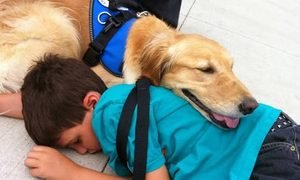
Does your child tend to seek physical contact, or do they avoid it? Are loud noises upsetting? Does sudden movement make people feel anxious? Does your child run, jump,p or move suddenly? Would your child like the idea of walking or playing with a dog? Does your child know when an animal would like to be left alone?
The answers might tell you more than a breed chart ever could.
Sensory Compatibility Can Be Huge
Dogs contribute sound, touch, smell, and movement to the home. For certain autistic children, that might be wonderful. The rhythm of rubbing a dog might have a calming effect. Soft fur can turn into a preferred sensory experience.
The presence of a dog nearby could provide a sense of comfort and predictability.
However, a different child could possibly dislike barking, licking, shedding, or the animal suddenly brushing against them.
Neither reaction is negative.
That’s the reason why it can be so helpful to meet dogs before you adopt them.
Calm Doesn’t Mean Lazy
Sometimes people think an ideal dog should be very quiet.
Not necessarily.
Certain autistic children have a fondness for active dogs.
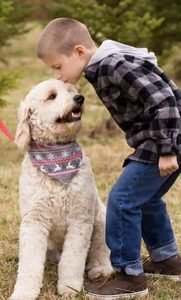
They could enjoy going for runs outdoors, playing fetch, walking along trails, or taking part in training. A more active dog could, in fact, promote movement and lead to shared activities. The question is whether the dog’s energy suits your child and your household.
Consider the Dog’s Tolerance
Children have not yet learned how to interact with animals. It is possible for a child to hug too tightly. Move suddenly. Make unusual sounds.
Omit a rule if you are excited. It by no means means that a dog should put up with being mistreated.
All dogs need a safe place where they can go and be left alone.
This makes it simpler to develop the relationship if you select a dog that is confident, friendly to people, and not easily startled.
Predictability Can Help
In special-needs households, routine is important.
It is natural for dogs to become a part of that routine.
Breakfast.
Morning walk.
After-school play.
Dinner.
Evening cuddle.
Children can look forward to the things they do repeatedly.
The dog also requires consistency.
Which is why the entire family, not merely the child, has to be prepared to take on the responsibility.
Consider an Adult Dog
It is common for families to imagine the occasion when they take a puppy home.
An adult dog, however, has one advantage: you get to see a great deal of its established personality.
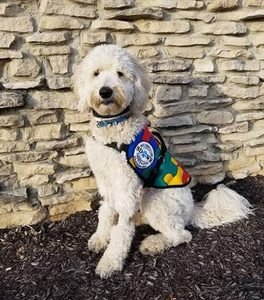
You probably already know whether the dog is calm around children, at ease with being handled, afraid of loud noises, very energetic, or just content to relax near them.
It can simplify the matching process.
The Relationship Matters Most
The object is not to locate a dog marked “good for autism.”
What we are aiming for is a relationship that works.
A child and a dog can eventually become inseparable.
Or the relationship might be quiet—a child watching television while a dog sleeps nearby.
Both can be meaningful.
The most beautiful relationships are often quite undramatic.
They then form part of ordinary daily life.
And that is why I wouldn’t begin by asking:
What breed should I get for my child who is autistic?
I would begin with:
What sort of dog would be at home in our child’s world, and what sort of dog would our child feel at ease living with?
That question can lead you to a much better match.