When people think of a “service dog,” they often imagine a dog guiding someone who is blind or assisting a person who uses a wheelchair.
However, service dogs can also help people with disabilities that are not obvious to others.
One type you might hear about is a psychiatric service dog, sometimes called a PSD.
There is still a lot of confusion about psychiatric service dogs. Are they the same as emotional support animals? Do they need special certification? What can they actually do?
If you are starting to look into psychiatric service dogs for yourself or a loved one, learning about these differences is a helpful first step.
What Is a Psychiatric Service Dog?
A psychiatric service dog is specially trained to do one or more tasks that help someone with a psychiatric disability.
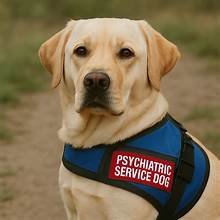
Under the Americans with Disabilities Act, a service dog must be trained to perform tasks directly related to the person’s disability.
This includes psychiatric disabilities.
This means psychiatric service dogs have the same basic ADA public-access rights as service dogs that help with physical disabilities.
It does not matter if the disability is visible or not.
What matters is that the person has a qualifying disability and the dog is trained to do tasks related to that disability.
Psychiatric Service Dog vs. Emotional Support Animal
This is one of the most misunderstood parts of the topic.
An emotional support animal can provide enormous comfort and companionship.
However, comfort alone is not considered a trained service dog task under the ADA.
A psychiatric service dog is trained to perform a specific task that helps a person with a disability.
For example, imagine someone experiencing severe anxiety.
One dog might sit next to the person, and having the dog close helps them feel calmer.
This can be valuable emotional support.
Another dog might be trained to notice when an anxiety attack is starting and respond by nudging the person, interrupting a behavior, getting medication, guiding the person away from a stressful place, or doing another trained action.
It’s the trained action that makes the difference.
The Department of Justice specifically explains that a dog trained to recognize an approaching anxiety attack and take an action to reduce its effects may qualify as a service dog.
What Can Psychiatric Service Dogs Be Trained to Do?
The right tasks depend on each person’s disability and needs.
There is no standard list of tasks that every psychiatric service dog must do.
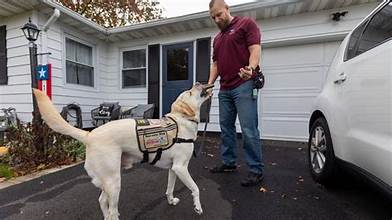
Some possible tasks include:
- Interrupting repetitive or harmful behaviors
- Reminding a person to take medication
- Retrieving medication or another needed item
- Grounding someone experiencing dissociation
- Waking someone from a nightmare
- Leading someone toward an exit during overwhelming situations
- Performing room or safety checks
- Interrupting escalating anxiety behaviors
- Providing a specifically trained physical response during a psychiatric episode
- Performing deep pressure therapy
- Helping a person remain oriented during an episode
The Department of Justice gives examples including medication reminders, safety checks, interrupting self-injurious behavior, grounding behaviors, and helping a disoriented person move away from danger.
The key is that the task must be connected to the person’s disability.
What About Deep Pressure Therapy?
Deep Pressure Therapy, or DPT, is a term you might often see when looking into psychiatric or autism service dogs.
With DPT, the dog learns to use physical contact or body pressure in a certain position as part of a trained response.
This might mean lying across someone’s legs, leaning against them, resting part of the body on their lap, or even just a long chin rest, depending on what the handler needs and the dog’s size.

But there is an important difference.
If a dog climbs into someone’s lap just because it likes to cuddle, that is not automatically a service dog task.
For service work, the behavior must be trained on purpose and linked to helping with the person’s disability.
We will take a closer look at DPT later this week, since families often find lots of descriptions online but not much about how the behavior is really trained.
Who Might Benefit From a Psychiatric Service Dog?
There is no simple checklist that says someone with a certain diagnosis automatically needs or qualifies for a psychiatric service dog.
Two people with the same diagnosis can have very different needs.
Instead, the real question is:
How does the disability affect daily life, and could trained tasks help with safety, independence, or daily functioning?
This conversation might include the person, their family, healthcare professionals, and experienced service dog trainers.
Having a service dog is also a big responsibility.
The handler or family still has to consider the dog’s:
- Daily exercise
- Veterinary care
- Feeding
- Grooming
- Training
- Public behavior
- Continued reinforcement of tasks
The ADA states that the handler is responsible for the care and supervision of the service animal.
A service dog can be a huge help, but it is not just a medical tool you can put away when you do not need it.
It is a living animal that needs care for its whole life.
Do Psychiatric Service Dogs Need Professional Training?
This is another question that often surprises families.
Under the ADA, a person with a disability may train their own service dog.
Federal ADA rules do not require the dog to graduate from a professional service-dog program.
But owner-training is not easy.
A dependable service dog usually needs to learn more than just one task.
The dog also needs to behave well and stay under control in public places.
This means learning to ignore food, people, other dogs, loud noises, shopping carts, children, strange floors, crowds, and many other distractions.
Some families can train their own service dog.
Others might need a lot of help from professionals.
Some may decide that getting a fully trained dog from an established organization is the best choice.
That is what we will talk about next.
You Don’t Need an Online “Certification” for ADA Public Access
Service dog certification is another area that can be confusing.
Some websites sell certificates, registrations, ID cards, or service dog vests.
But the ADA does not require a service dog to have certification, registration, or a special vest.
If it is not clear what a service dog does, staff at public places can usually ask only two questions:
- Is the dog a service animal required because of a disability?
- What work or task has the dog been trained to perform?
They cannot ask for a service dog certificate as proof of ADA public access rights.
This is important because families might spend money on documents that do not actually give federal service dog rights.
A Psychiatric Service Dog Is About Tasks, Not Labels
If you remember just one thing from this article, let it be this:
A psychiatric service dog is not defined by a vest, certificate, breed, or title.
It is about the connection between a person’s disability and the trained work the dog does to help.
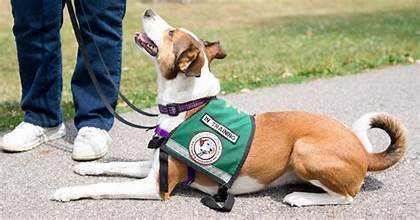
That is why it is so important to look into the actual tasks.
Instead of starting with:
“Where can I get a psychiatric service dog?”
Sometimes, a better first question is:
“What specific things would I need a service dog to help me do?”
Once you know what you need, it becomes much easier to decide on training, pick a dog, and find professional help.
In our next post, we will look at one of the biggest decisions families face:
Should you obtain a professionally trained psychiatric service dog, or can you train one yourself?